Two years into our five-year strategy, we have accelerated the delivery of the key strategic projects identified in our review. These projects will help us to better deliver against our core mission: to raise funds to save, protect, and rebuild the lives of people impacted by emergencies and major disasters overseas.
The DEC has a unique role in how we can drive real change within the humanitarian sector and increase collective impact through our member charities and their local and national partners.
During this strategic period we are focusing specifically on:
- Harnessing our collective impact
- Influencing the sector
- Exploring and strengthening our climate change and protracted crisis response
- Supporting a shift of power
Harnessing our collective impact
‘Collective initiatives’ are joint projects where DEC member charities and their local partners work together to address challenges or gaps in the humanitarian response. This year the DEC invested dedicated funds for innovation and collaborative projects for the Middle East Humanitarian and Myanmar Earthquake appeals, alongside its continued funding of lifesaving emergency response and recovery assistance. For the Middle East Humanitarian Appeal, this included helping communities prepare for predictable risks through early warning systems and local response plans; grants for community groups that are already supporting local people; funding and tailored support for women-led organisations; and using technology to improve access to safe water in conflict-affected areas.
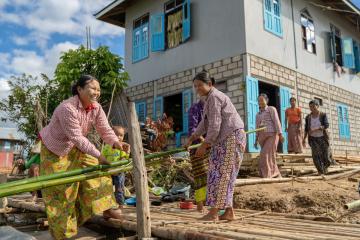
In the Myanmar Earthquake Appeal response the DEC is funding five initiatives that include helping local communities prepare for environmental shocks and future crises; a locally-led pooled fund providing grants to local civil society organisations; tailored wellbeing support for people working on the humanitarian response; flexible grants for women-led organisations; and more proportionate due diligence processes to help local organisations access funding and opportunities more easily.
Collective initiatives provide the space to do things differently, fostering locally-led approaches, collaboration and leading to lasting, positive changes in how our members and partners work together
Supporting a shift of power
Local partners are usually the first and last responders in a crisis and they have the cultural and contextual knowledge and relationships that mean they are best placed to fully understand and meet the needs of their communities. The DEC is committed to supporting a lasting shift of power - knowledge, resources, funds and decision-making ability - to local actors.
In the Myanmar Earthquake Appeal response, local partners have been vital, ensuring our collective ability to reach different communities. In the first six months of the programme, 60 percent of funding went to local actors. We provided spaces to bring these local groups together so that they could shape the response.
Influencing the sector
The DEC generates a significant body of evidence and learning, and we are increasingly using this to inform and influence the wider humanitarian sector. Our research and learning agenda identifies key priority areas where we aim to drive sector improvement. We have a multi-year partnership with the research organisation the Humanitarian Advisory Group to support this work including a study that is currently underway to explore how organisations fulfil their duty of care toward staff and volunteers working on humanitarian responses.
The DEC is committed to being a flexible source of funding and is working to evidence what advantages this can bring such as adaptive programming so that humanitarian actors can better respond to the changing needs of communities in crisis.
Responding to climate change and protracted crises
The DEC monitors a number of large-scale disasters that do not generate media interest and public awareness. The nature of many crises is becoming increasingly protracted as regions experience long term conflict, often compounded with climate induced risk. The humanitarian sector faces a significant challenge in meeting the basic needs of affected people as these emergencies are also under-resourced.
We have a strategic commitment to explore effective ways to drive awareness and funds to these protracted humanitarian emergencies. Understanding climate change and protecting the environment is increasingly important in the humanitarian sector. It is now a DEC membership requirement to be a signatory to the Climate and Environment Charter and we are supporting our members to adopt the commitments of the charter in order to strengthen climate resilience and environmentally responsible programming.