Dr Niveen
Dr Niveen

Middle East
Humanitarian Appeal

Middle East
Humanitarian Appeal

Stories from the frontline

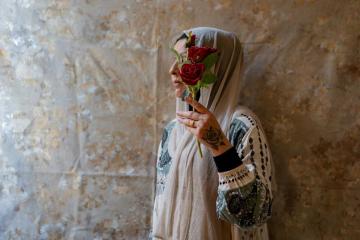
Dr Niveen, a mental health practitioner for the Palestine Red Crescent Society (PRCS) in Gaza,. Image: Aboud ​Alsayed/​Arete/​DEC

Image caption: X

Since the DEC Middle East Humanitarian Appeal launched in October 2024, escalating conflict has continued to devastate lives in Gaza, Lebanon, the West Bank and Syria. 

In response, the UK public has raised over £67m for the Middle East Humanitarian Appeal, helping to deliver food, clean water, medical care, mental health support and so much more to people living in unimaginable conditions.

All of this incredible support has only been possible thanks to the dedication and resilience of local aid workers and frontline staff. 

Many continue to live and work in extremely difficult conditions every day, facing personal risks as they help others to survive and live with dignity. They all have their own stories to share. 

Dr Niveen

Dr Niveen holds one of the dolls used by her team to help children affected by the conflict express their feelings and begin to process their experiences, 5 August 2026. Image: Aboud ​Alsayed/​Arete/​DEC

Image caption: X

Dr Niveen

Dr Niveen is a mental health practitioner for the Palestine Red Crescent Society (PRCS), a local partner of DEC charity British Red Cross. Here she holds a doll from the child friendly space she helps to run.

“The nature of humanitarian work means going deeper into people's problems and the painful experiences they have been through. So, we end up opening many psychological wounds and try, as much as possible, to close them properly.”

The space runs various sessions and activities for children affected by conflict-related trauma at a PRCS centre in Gaza which is supported by DEC funds. During the most recent conflict, her family was displaced from their home. She now lives in temporary accommodation with her four children.  

Dr Niveen with her children

Dr Niveen looks at photos from before the conflict with her children in their home in Gaza, 5 August 2026. Aboud ​Alsayed/​Arete/​DEC

Image caption: X

“I told my children, we have to think of this tent as our shelter and our home. I’ll never forget those words. Imagine moving from a home where you have your privacy, your dreams and your memories, to living in a tent where the bathroom, kitchen and beds are all in the same space. It was extremely difficult.” 

“One of the things that keeps me at ease and motivates me to continue this work is the impact I see when I work with someone. I measure my love for this profession, and my commitment to it, by the impact I see on the people who receive the psychological support I provide.”

Dr Niveen out in the field

Dr. Niveen makes her way to a centre where she supports children affected by conflict-related trauma, 15 November 2025. Image: Aboud ​Alsayed/​Arete/​​British ​Red ​Cross

Image caption: X

“I’ve met many children who have been displaced nine times, 15 times, even 17 times. One of the things that keeps me at ease and motivates me to continue this work is the impact I see when I work with someone. I measure my love for this profession, and my commitment to it, by the impact I see on the people who receive the psychological support I provide.”

“The message I would like to send to the British people is that every penny you give to Gaza, or to the children of Gaza, can help them smile and keep going with their lives, it brings joy and a smile to a child, whether by buying a toy, organising an activity, or providing a safe space for that child.” 

Anwar holds up bottle of water

Anwar uses a pH meter to test that the water he distributes to displaced communities is safe to drink, 6 August 2026. Image: Abood ​Al ​Sayd/​Arete/​DEC

Image caption: X

Anwar

Anwar, a water and hygiene supervisor for DEC charity Concern Worldwide's local partner in Gaza, holds a water salinity metre. He uses this to test that the water he distributes to displaced communities is safe to drink, bringing life-saving drinking water to thousands.

"This meter is an essential tool in my daily work. I use it in the field to measure the salinity of drinking water, both at the water source and at distribution points where water is delivered to families"

He joined the response a year after the conflict escalated in January 2024, at the time, just like most others in Gaza, he and his family were suffering from the issues like the shortages of water, food, medicine, and the insecurity of displacement.

“During our response to provide drinking water and domestic water, we implemented many projects under the DEC. In the last month, we rehabilitated and restored water for one main municipal water well in an area of Gaza City. This area had been totally destroyed; the buildings, the streets, the infrastructure, and the old water well was all destroyed.”

Anwar on his balcony in Gaza

Anwar drinks coffee and tends to plants with his wife, Ola, in their home in Gaza, 23 July 2026. Image: Abood ​Al ​Sayd/​Arete/​DEC

Image caption: X

“We all suffer from the same issues. When the war started, we were shocked and scared by the situation around us. I was responsible for my family and my sister's family.  

"Like any other person or family in Gaza, we suffer from the same issues, like the shortage of water, food, medicine, and the insecure situation, stress and pressure, fears. All of these emotional feelings make me stronger. Because I need to find the basic things for my family, this has encouraged me to support other people because now we are one people, we have to support each other."
 

Anwar

Anwar oversees a DEC funded water distribution at a camp for displaced people in central Gaza, 6 August 2026. Image: Abood ​Al ​Sayd/​Arete/​DEC

Image caption: X

"We provided safe drinking water to thousands of families during our work with support from the DEC and Concern, and we are still doing it to relieve the suffering of the people"

Anwar speaks of a widowed mother and her three daughters with disabilities, who were struggling to access safe and private sanitation. With DEC funded support, he personally ensured a latrine was installed beside their tent, giving the family greater dignity, safety and comfort.

“I'm very proud of what I do. Of course, it is a small intervention, but it means a lot that I succeeded in relieving the stress and the fear and the worries from those vulnerable families.”

Sahar

Sahar holds a food parcel of fresh fruit and vegetables for families displaced by the conflict, 10 August 2026. Image: Aboud ​Alsayed/​Arete/​DEC

Image caption: X

sahar

Sahar holds a food parcel distributed in Gaza by the Palestinian Development Studies Association (PDWSA), a local partner of DEC charity ActionAid. She has led the organisation’s humanitarian response throughout the conflict, providing food, shelter and essential support to women and families.

Sadly, even with her position of President of PDWSA, Sahar herself has been displaced many times, marginalised and as much in need of support like the women she helps.

"I found myself, as the head of a women’s organisation that had provided services for years, completely cut off from people and from my professional network, unable to secure even the basic things my family needed to survive."
 

Sahar holds apples

Sahar holds up four apples to the camera, 10 August 2026. Image: Abood ​Al ​Sayd/​Arete/​DEC

Image caption: X

“My husband’s family had a house, so we went there during the first displacement. There were about five families in that house, women, men, and children, all living together in one place. We had barely begun to settle when we were forced to leave and the question became: Where do we go now?”

"The responsibility that fell on everyone’s shoulders, fathers and mothers alike, was to survive, to save ourselves and our children first. Keeping our families safe became our priority".

“We went through an extremely difficult winter, with nothing to keep us warm, no blankets, mattresses, or adequate clothing. I found myself completely cut off from people and from my professional network, unable to secure even the basic things my family needed to survive.”

Sahar

Sahar selects fresh fruit and vegetables at a local market for distribution to families struggling to access food as a result of the conflict in Gaza, 7 July 2026. Image: Aboud ​Alsayed/​Arete/​DEC

Image caption: X

“With the support of DEC and ActionAid, we were able to buy vegetables and deliver them to families in need. The need was urgent, and people were extremely grateful for the assistance.”

“Over the past three years, we have been able to reach nearly 50,000 women. The moment people received food, it was as if they had been given a great treasure. We could see the joy and happiness on the faces of children and women when they received a food parcel.”

Cyril, and aid worker in Lebanon for CARE international

Cyril poses for a photo wear he works in Lebanon, 20 July 2026. Image: Laura ​Menassa/​Fairpicture/​DEC

Image caption: X

Cyril 

Cyril is a communications and advocacy coordinator at DEC charity CARE International in Lebanon. His work focuses on supporting women and girls impacted by the conflict living inside and outside of collective shelters in Lebanon.

“Every single item that we have been distributing through the aid and the support of DEC has made a huge difference in the lives of women and girls and all internally displaced people that we have been meeting on a daily basis because they have nothing.”

Cyril, and aid worker in Lebanon for CARE international

Cyril, communications and advocacy coordinator at DEC charity CARE International in Lebanon, pictured in him home in Beirut. Image: Laura ​Menassa/​Fairpicture/​DEC

Image caption: X

“Time and time again, people would tell us that the most important thing that CARE is able to offer them is the time that we spend listening to them, because when we listen to them, they feel seen and they feel heard. This is when we know that we are able to contribute to rebuilding their souls, rebuilding their minds and rebuilding their spirits.”

“There are specific times for me as a human being, especially when I see children that look exhausted, it stays with me. I go home and I think of them. This is why I wake up the next day and I do what I do, with a sense of urgency and energy, and to make sure that I'm doing as much as I can.”

Farah

Farah stands holding her aid worker vest in Lebanon, 29 July 2026. Image: Laura ​Menassa/​Fairpicture/​DEC

Image caption: X

farah

Farah is a project officer for DEC charity Islamic Relief in the Bekaa Valley, Lebanon. She works with her colleagues to provide food, clean water and hygiene support to displaced families living in shelters.

“As aid workers, we stay awake all night listening to the bombing and the airstrikes. And in the In the morning, we need to be there, standing behind and in front of these people. Listening to them, supporting them, serving them and providing for them.”

“My message to people in the UK who are supporting humanitarian aid is very simple. Every single act of support makes a great difference, because the need is so great. The crisis is big, and people are in need. People rely on us, and we rely on you. So every single act of support will make a great difference.”

Donations from the UK public to the Disasters Emergency Committee’s Middle East Humanitarian Appeal - now more than £67 million - have meant that these incredibly resilient workers have had the funds needed to continue delivering support.